The interactive room view is unavailable on this device.

See beyond the horizon
with PHASE.

PHASE is a search-and-rescue system that combines Wi-Fi sensing and audio analysis to help detect signs of life and reduce response time.

01SYSTEM ARCHITECTURE

Swipe to explore the full diagram

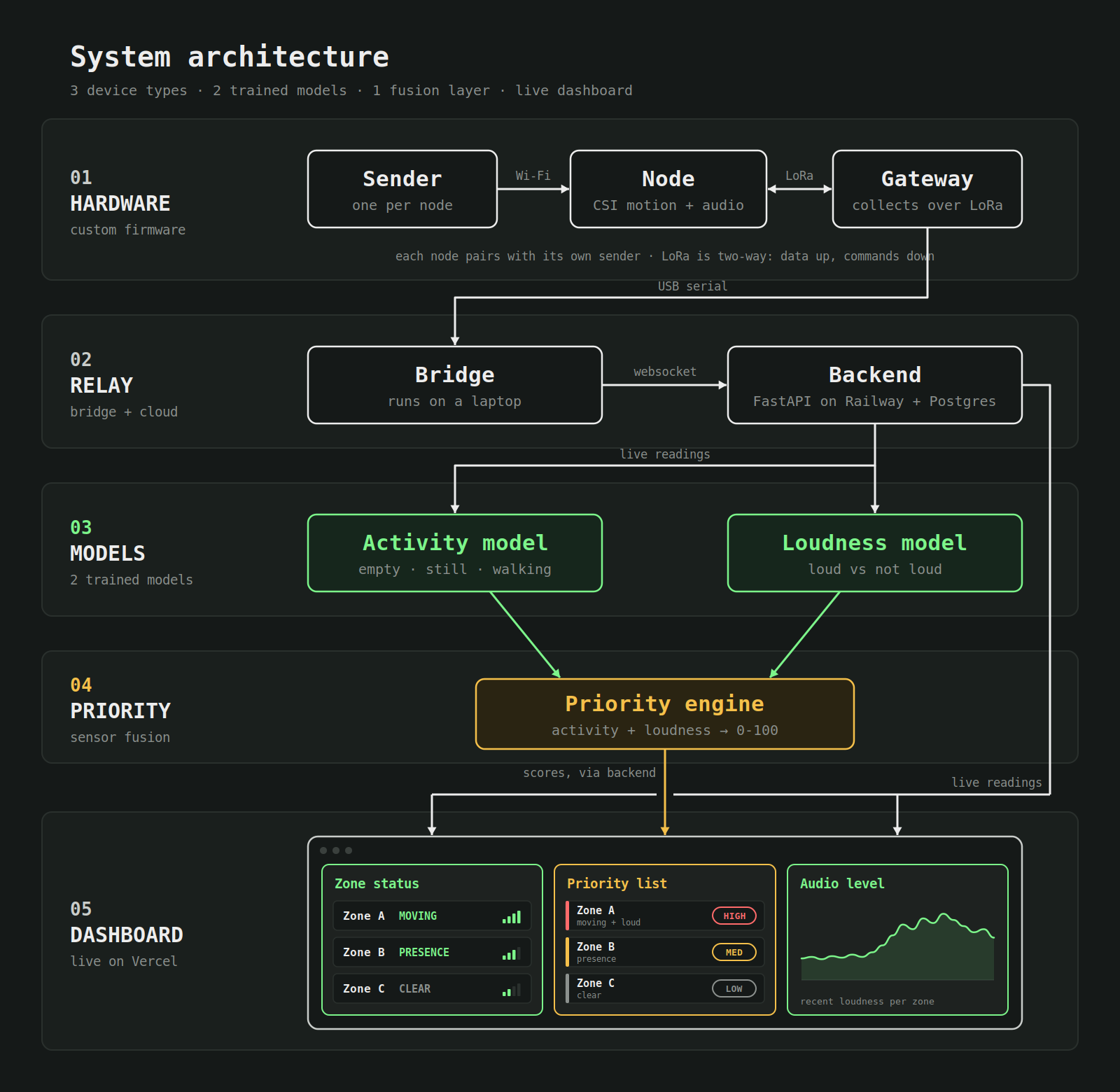
System architecture diagram in five numbered layers. 01 Hardware: each node pairs with its own Wi-Fi sender and talks to a gateway over two-way LoRa. 02 Relay: a bridge on a laptop forwards readings over USB serial and a websocket to a FastAPI backend on Railway with Postgres. 03 Models: an activity model and a loudness model. 04 Priority: a fusion engine that turns activity and loudness into a 0 to 100 score. 05 Dashboard: the live Vercel view with zone status, a priority list, and audio level.

02NETWORK ARCHITECTURE

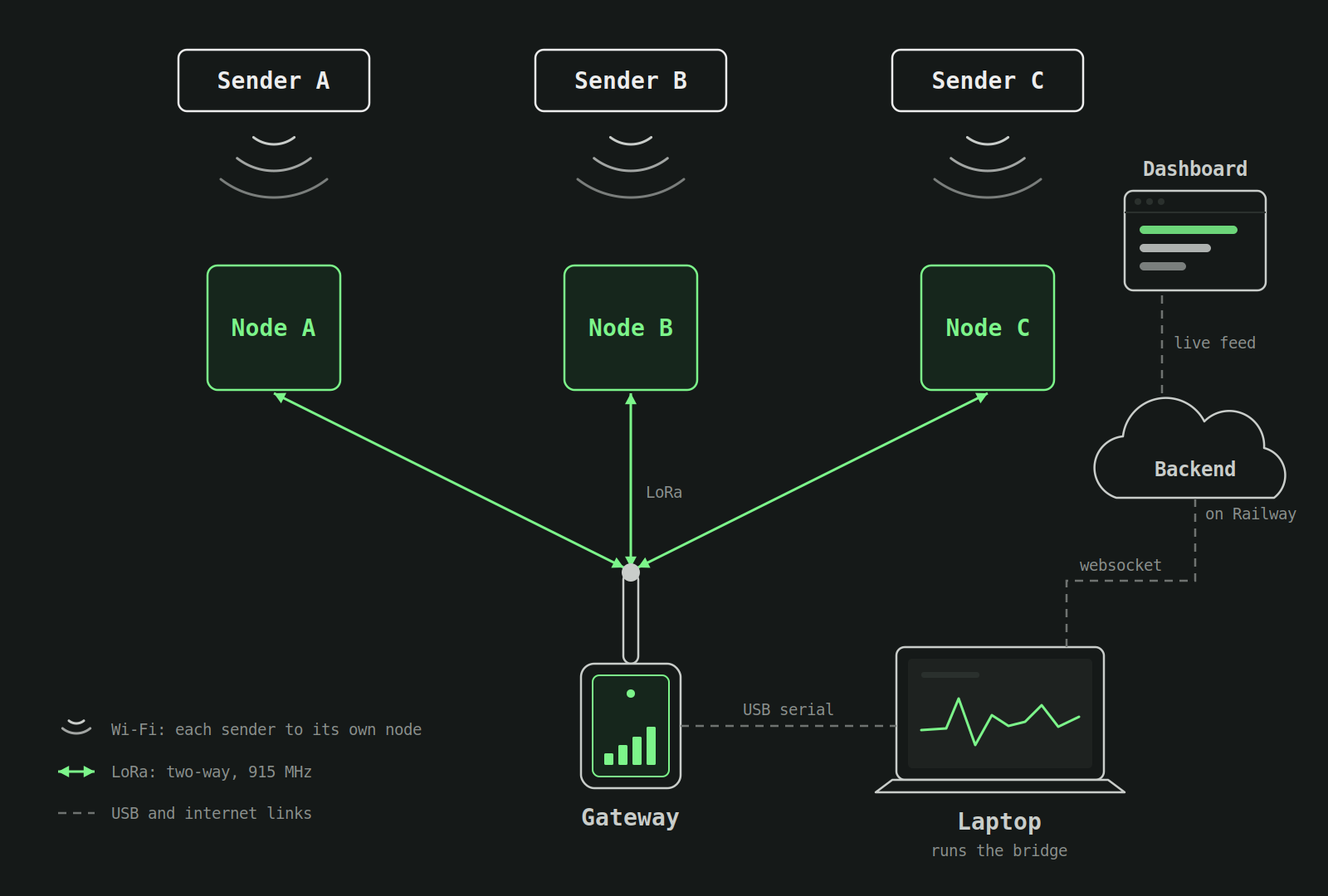
Network diagram. Senders A, B, and C each broadcast over Wi-Fi to their own paired node (Node A, Node B, Node C). All three nodes report to a central gateway over two-way 915 MHz LoRa. The gateway connects by USB serial to a laptop that runs the bridge, which sends data over a websocket to a backend on Railway that feeds a live dashboard.

How to deploy

  1. 1

    Place the network

    Position three sensing nodes around the area, each paired with its own sender. The nodes report their observations to a central gateway.

    3 nodes, 3 paired senders, 1 gateway
  2. 2

    Sense and listen

    Each node observes changes in its paired sender's Wi-Fi signal through channel state information (CSI). Node microphones provide audio samples for a model designed to flag possible human screams.

    Wi-Fi CSI + audio classification
  3. 3

    Review the room view

    The gateway brings the observations together for a display of possible areas of activity that responders can assess and verify on site.

    Estimated activity, human verification
03HARDWARE

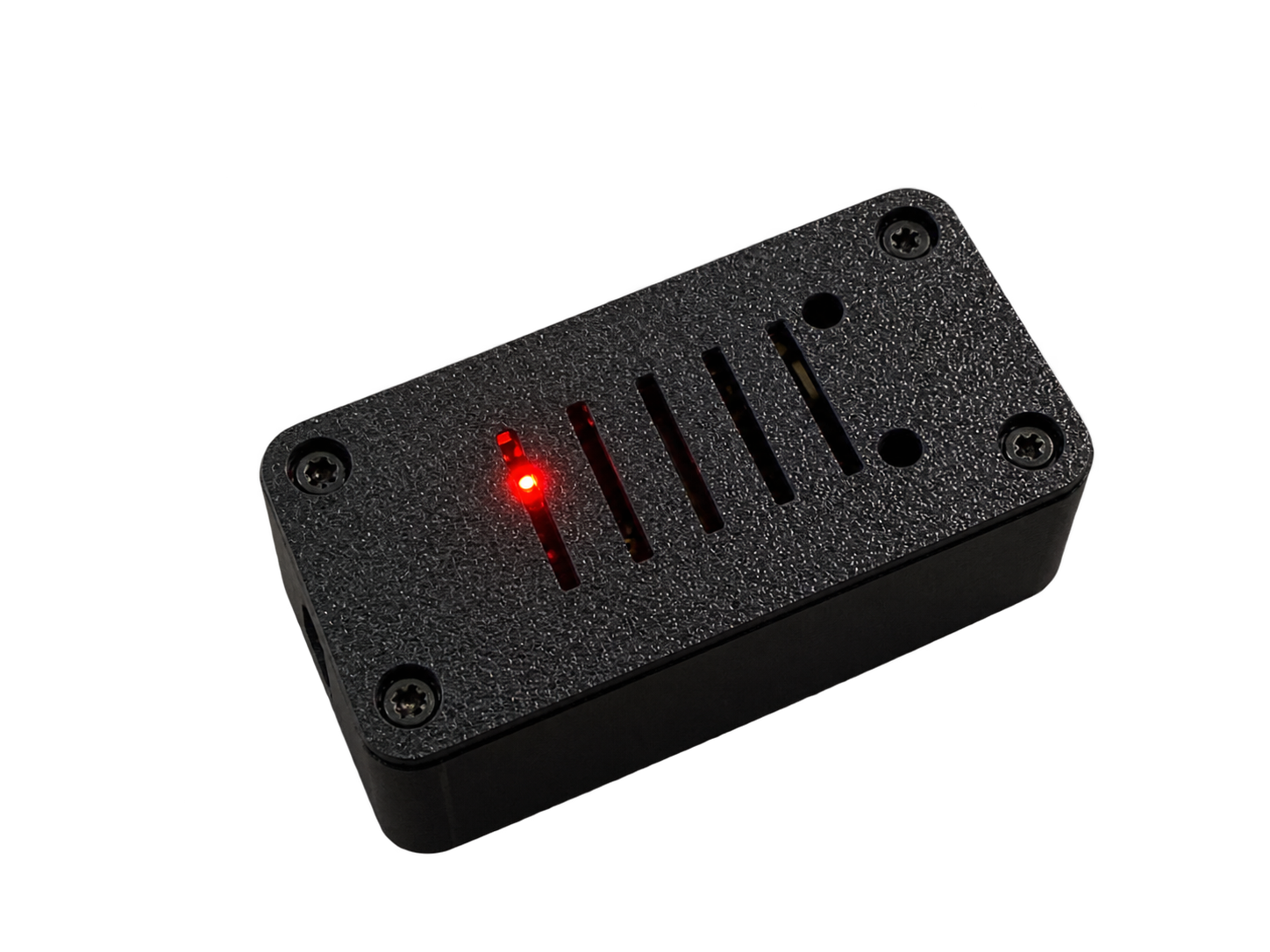
A paired sender: a small black enclosure with ventilation slots on top and a glowing red status LED.

Paired Sender

Pairs with one node and transmits Wi-Fi frames continuously, giving the node a steady signal to measure.
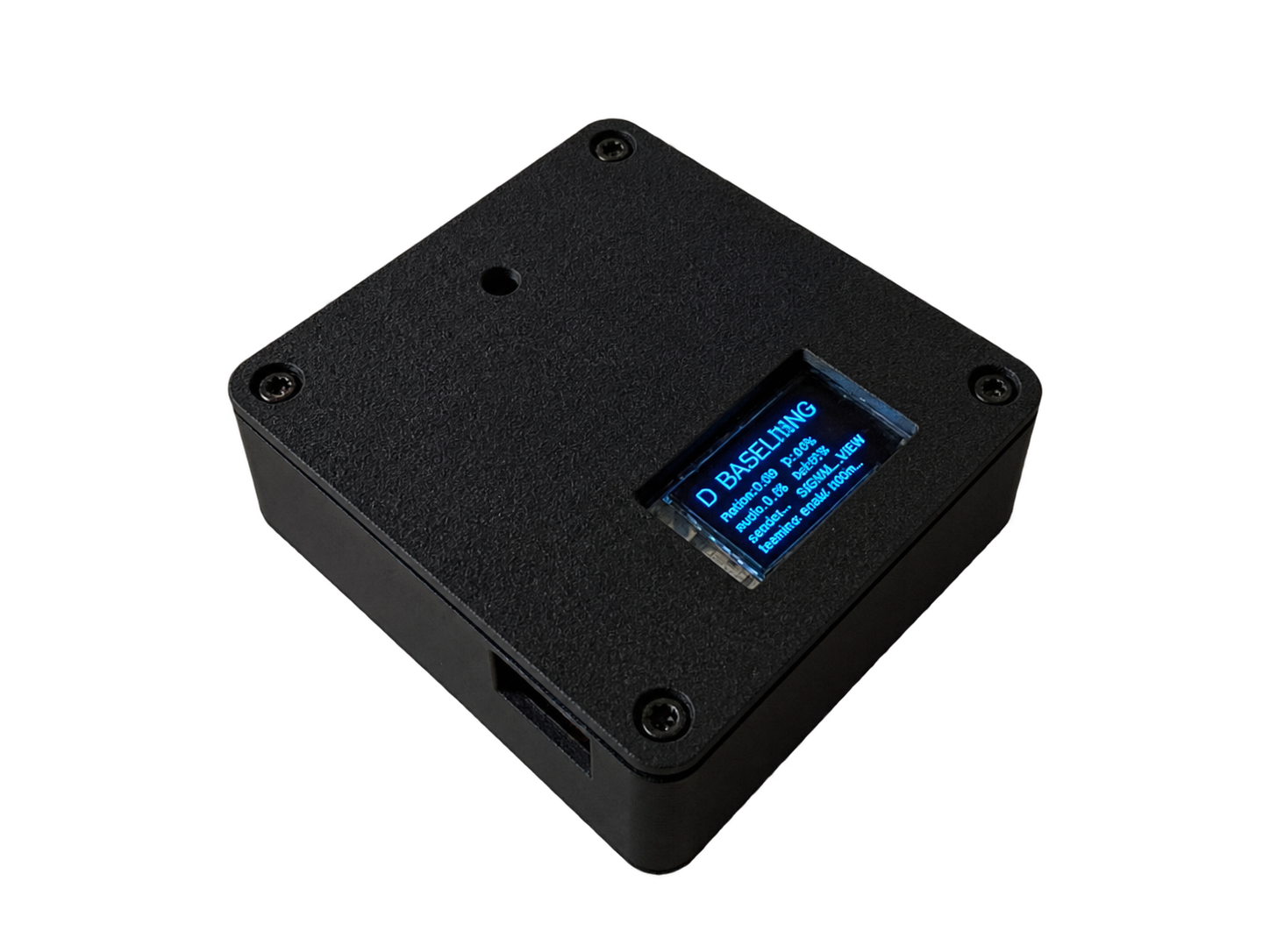
Angled view of a sensing node showing the compact black enclosure, OLED display, and side port.

Sensing Node

Detects motion from changes in its sender's Wi-Fi signal, measures how loud the area is, and reports both to the gateway over LoRa.
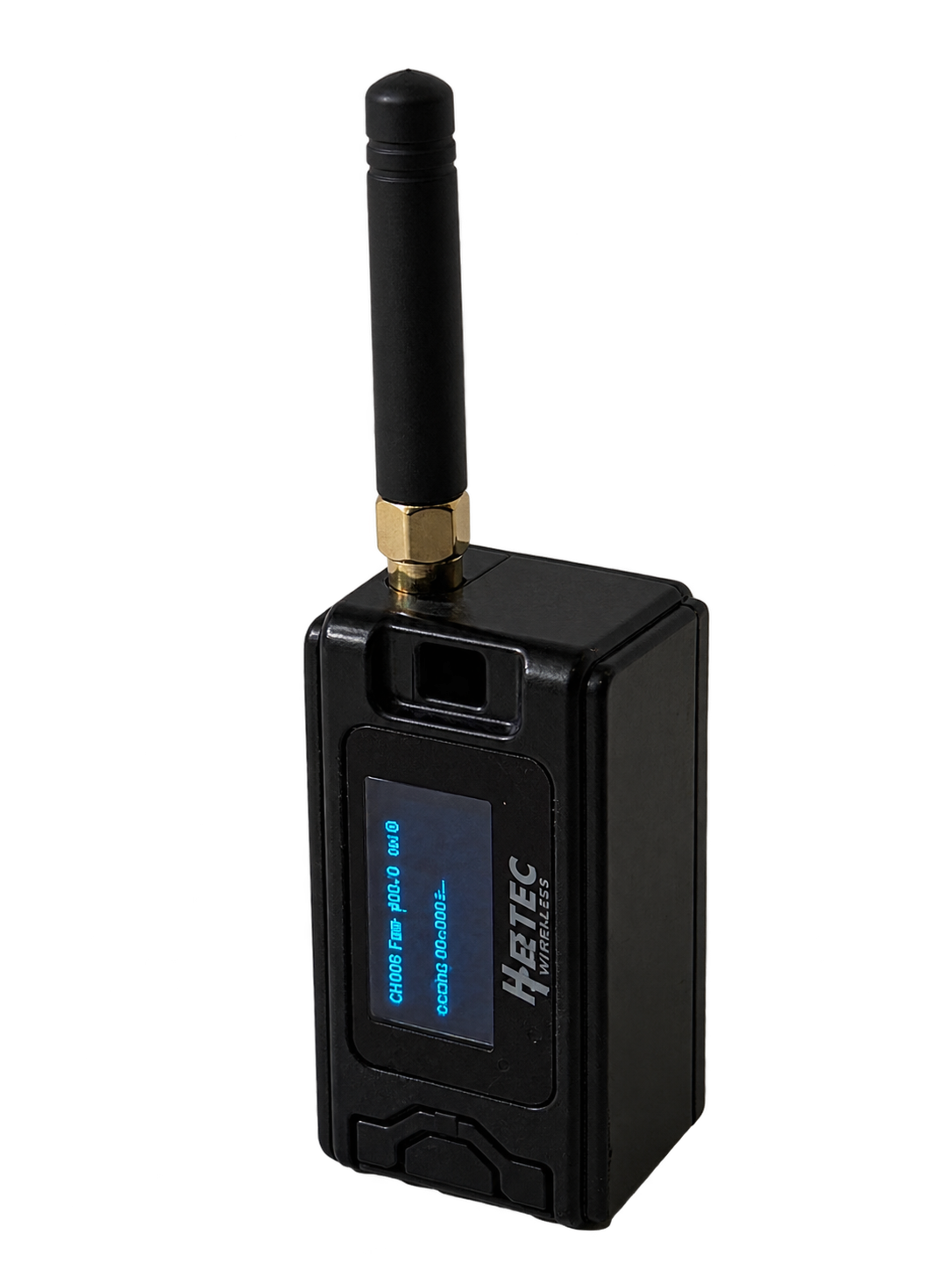
Gateway device: a black handheld enclosure with an external antenna and a small OLED display.

Central Gateway

Receives readings from every node over two-way LoRa, confirms each one, sends commands back when needed, and passes the data to the laptop over USB.
04ML ARCHITECTURE
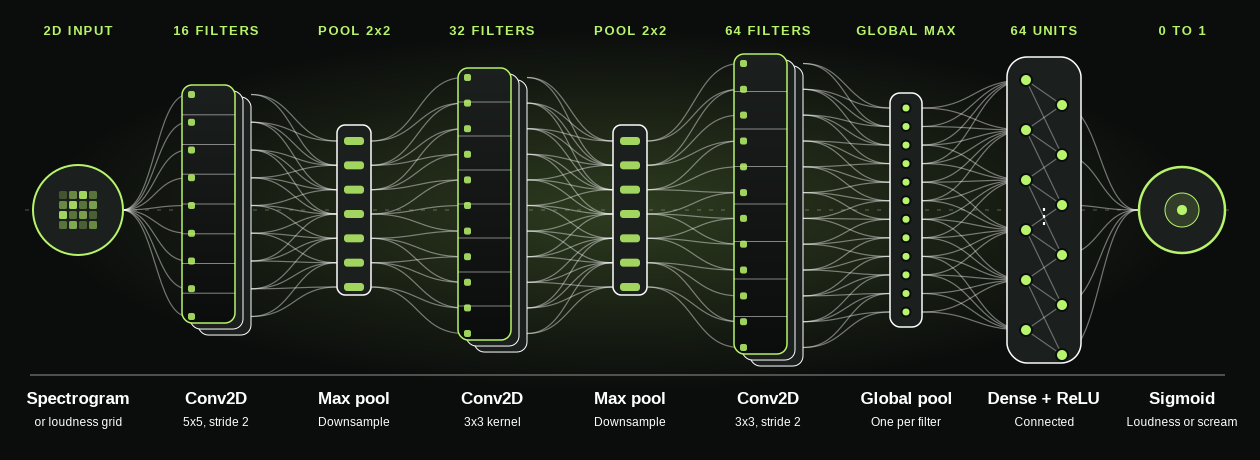
AUDIO MODEL NETWORK / LOUDNESS AND SCREAMSHARED CNN ARCHITECTURE
Convolutional network shared by both audio models. A two dimensional input, a spectrogram for the scream model or a grid of recent loudness readings for the loudness model, flows through Conv2D 16 filters (5 by 5, stride 2), 2 by 2 max pooling, Conv2D 32 filters (3 by 3), 2 by 2 max pooling, Conv2D 64 filters (3 by 3, stride 2), global max pooling, a dense layer of 64 ReLU units, and a sigmoid output giving a 0 to 1 score.
Both audio models share this network. The loudness model runs live on node readings, while the scream model is experimental and runs on a laptop microphone. Either way, a score never establishes a person's location or replaces on-site verification.
05USER CASE

In a rescue, every second spent searching the wrong spot can cost a life.

01

Sees through smoke and debris

Our star network is designed to detect movement and breathing where cameras go blind, even when survivors cannot call for help.

02

Scans the whole scene at once

Instead of one radar checking one spot at a time, the receiving nodes monitor their zones simultaneously and report to a central gateway.

03

Low cost, deployed in minutes

Built from low-cost nodes, the system is designed for rapid placement and calibration, giving responders a live view of where to search first.

06FUTURE DEVELOPMENTS

Pre-installed

Prepared buildings

Fixed nodes could provide known coverage and repeatable placement in buildings equipped ahead of an incident.

WhenBefore an emergency
TradeoffRequires installation and upkeep
Deployed on scene

Portable placement

Responders might position temporary nodes, potentially with drones, when a building has no installed system.

WhenDuring a response
TradeoffCoverage depends on placement

Contact us

Email
selenayingyuan@gmail.com
Phone
561-331-3531